Comparison/E2E Testing Services

They test the surface. We test the system.

UI-based testing platforms test clicks and screenshots, not business logic. The surface is fragile. The bugs that matter live underneath.

Surface vs. system.

E2E testing services like QA Wolf, Mabl, and Testim test the browser surface — clicks, screenshots, and rendered UI. TraverseTest tests the system underneath — API requests, database mutations, webhook handlers, and state transitions. Most production incidents originate in the system layer, not the surface.
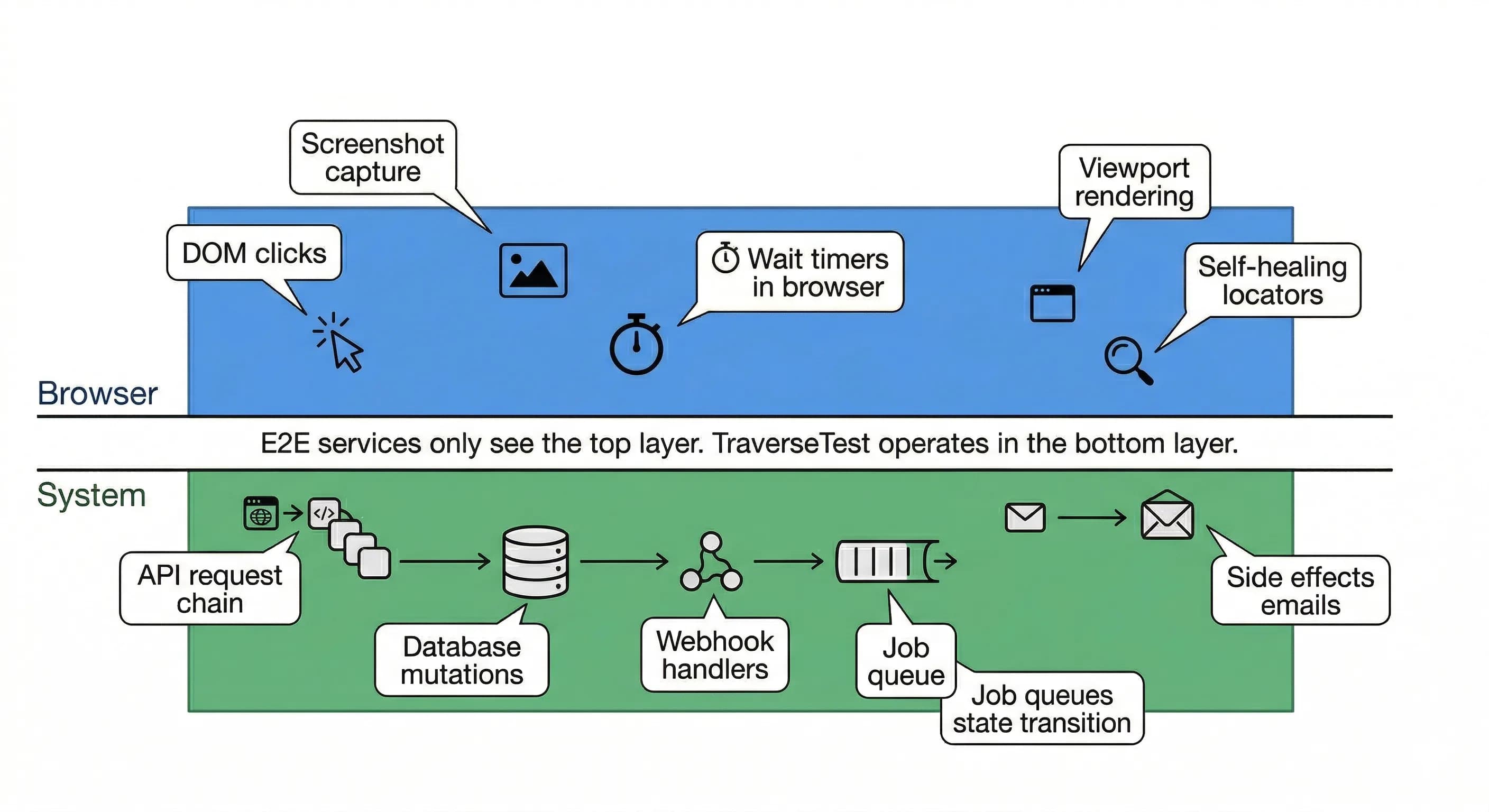
Two layers: the Browser surface layer (blue) showing DOM clicks, screenshot capture, wait timers, viewport rendering, and self-healing locators — what E2E services test. Below it, the System layer (green) showing API request chains, database mutations, webhook handlers, job queues, state transitions, and side effects — where TraverseTest operates.
QA Wolf / Testim — browser test
Launch Chrome
Navigate to /checkout
Click "Add to cart"
Fill shipping form
Click "Pay now"
Assert: "Order confirmed" visible
UI test passes

Can’t see: webhook retry fires twice, charging $200 for a $100 order

TraverseTest — API journey test
POST /api/orders { items: [...] }
stripe.charges.create triggered
webhook: invoice.paid received
processWebhook() called
retry triggered (timeout)
processWebhook() called AGAIN
✗ FAIL: Duplicate payment record
Root cause: missing idempotency check
File: src/lib/webhooks.ts:34

Catches the real bug. Traces through the full API journey, including retries, side effects, and database state.

What browser tests can't see.

Webhook race conditions

A payment webhook retries while the first is still processing. Both succeed. Customer charged twice.

webhooks.ts
async function processWebhook(event) {
// No idempotency check!
const charge = event.data.object;
await db.payments.insert({
amount: charge.amount,
stripe_id: charge.id // duplicate!
});
}

Stale data in cron jobs

Nightly billing reads cached subscriptions. User downgrades 5 min before. Charged at old rate.

billing-cron.ts
const subs = cache.get('active_subs');
// Cache set 6 hours ago!
for (const sub of subs) {
await stripe.charges.create({
amount: sub.price, // stale!
customer: sub.customer_id
});
}

Transaction boundary gaps

Invoice created, charge fails mid-way. Orphaned invoice, no payment record.

checkout.ts
async function checkout(order) {
await db.invoices.insert(invoice);
// No transaction wrapper!
const pay = await stripe.charge(amt);
// If this throws → orphaned
await db.payments.insert(pay);
await sendReceipt(user.email);
}

Side by side.

TraverseTest vs E2E Testing Services
Capability
E2E Services
TraverseTest
Test generation
Manual recording or scripting
Automatic from code analysis
Test level
UI / browser DOM
API + database + side effects
Catches backend bugs
No — only rendered output
Yes — full request lifecycle
Diagnoses root cause
Screenshots & videos
Exact code line + SQL + state
Suggests & verifies fixes
No
Yes — opens verified PRs
Maintenance
High — breaks on UI changes
Zero — no UI dependency
Flaky tests
Inherent — browser timing
Deterministic
Setup time
3–4 weeks
12 minutes
Annual cost
$60K–$500K
Free (early access)
Lock-in
Tests live on their platform
Exportable YAML — you own it
Visual regression
Yes
No
Responsive layout
Yes
No
Drag-and-drop / UI logic
Yes
No

E2E services are genuinely good at visual and interaction testing. We complement them, not replace them. Use both — they catch different bugs.

See it on your codebase.

We’ll analyze a small feature and show you what feature-level tests look like. Also compare us to AI test generators and coverage tools.

Free12-min setupRead-only repo accessNo lock-in